Hunter Road-Force Balancing.
Match-mounted against radial force variation.
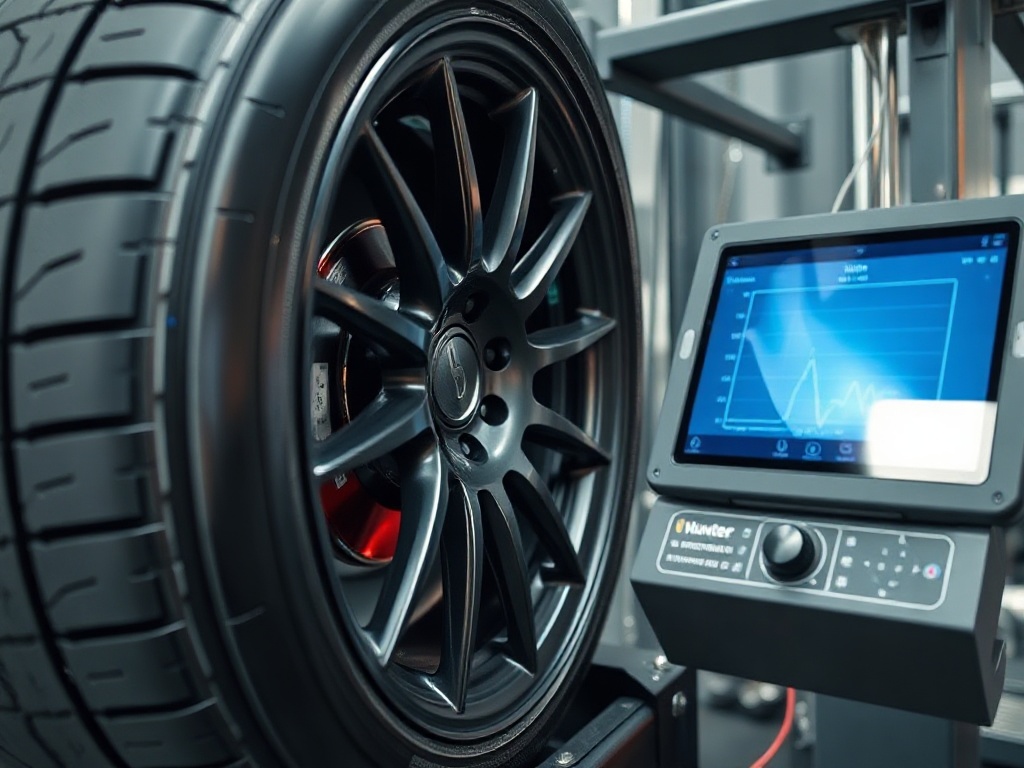
A standard spin balance corrects static weight — it does not measure how a tyre and wheel behave together under load at speed. The Hunter road-force balancer reads radial force variation — the harmonic test a spin balance cannot run.
- Marques
- BMW M · AMG · Porsche · Audi
- Detects
- RFV · LFV · Conicity
- Process
- Match-mount · load-rolled
- Equipment
- Hunter Road-Force Elite

/public/photos/road-force-bay.jpgWhat road-force detects
Four measurements a spin balance cannot make.
The Hunter road-force balancer simulates a load-rolling contact patch against the fitted tyre/wheel assembly and measures how the assembly itself behaves at speed — not just how the mass is distributed around the axle. These are the four readings it captures and the reason they matter on a staggered or low-profile fitment.
Force peaks across a single rotation under a simulated load.
High RFV is the primary cause of the highway-speed vibration that a freshly spin-balanced tyre still produces. The roller presses the contact patch with a known load and reads the assembly's force peaks — a peak of more than ~12 lbs flags an assembly that will not run smooth regardless of how well the static balance is corrected.
Side-to-side force the assembly generates as it rotates.
LFV is what produces the tram-tracking feel on a perfectly balanced wheel — a steady pull to one side at speed that geometry alone cannot explain. The roller reads the side force under load; match-mounting against LFV data resolves it without adding tyre/wheel weights.
The tyre's tendency to roll in a slight cone shape rather than true.
A tyre that rolls in a cone shape loads one shoulder harder than the other and produces uneven shoulder wear independent of alignment. Ply steer is the same measurement in the side-plane. Both are captured by the road-force balancer; both are correctable by match-mounting.
Per-tyre uniformity grade from the OEM tolerance band.
Premium-fitment tyres (Michelin Pilot Sport, Continental SportContact, Pirelli P Zero, Goodyear Eagle F1) carry per-tyre uniformity grades from the manufacturer. The Hunter balancer reads the grade off the serial and shows where that tyre sits against the spec — useful when planning a fitment that has to return smooth.
Why high-tolerance platforms need it
Staggered fitments,
low-profile sidewalls, OEM-spec match-mount.
Staggered fitments, low-profile sidewalls, run-flats. The OEM service information for BMW M, Mercedes-AMG, and Porsche platforms recommends match-mounting against road-force data.
Any RFV on a RWD/AWD platform transmits through half-shafts, transfer case, and differential. Match-mounting is what keeps the wear pattern even from corner 1.
When you need road-force verification
Four triggers worth a road-force read.
Road-force verification is the right next step when a vibration remains after a spin balance, or whenever a fitment has changed and the OEM expects match-mounting.
- 01
Highway-speed vibration after a fresh spin balance.
Weights on, balance read green, vibration still there at 90–120 km/h. Spin balance does not measure radial force variation; the road-force balancer does. The cause is almost always an RFV peak a spin balance cannot detect, correctable by match-mounting — not by adding more weights.
- 02
New staggered or low-profile fitment.
Any new staggered set (different-section tyres front-vs-rear), any new 35- or 30-series fitment, and any new run-flat should be match-mounted before it goes on the car. The OEM service information for these platforms recommends it; skipping it loads the drivetrain from corner 1.
- 03
Pre-purchase inspection on a used luxury car.
A used BMW M, AMG, or Porsche on a new-to-you fitment should be road-force verified before purchase. The previous owner's wheel weights and balance state cannot be trusted; the only way to know what you're buying is a read against the assembly itself, not the assembly's history.
- 04
Seasonal changeover — summer-to-winter or winter-to-summer.
Seasonal sets are stored for six months under uneven pressure and temperature, then remounted on the car. Each set returns to the wheel with whatever deformation happened in storage. A road-force verification at changeover catches that variation before it shows up as a vibration 50 km into the first drive.
What your visit looks like
The MFP four-step protocol — applied to road-force.
Every road-force verification follows the same four-step sequence, executed once with nothing skipped and nothing added. The same protocol runs whether the visit is a standalone road-force read on a new fitment or the verification step at the end of an alignment visit.
- Step 01
Wheel off the car, cleaned, mounted.
Existing wheel weights removed. Mounting face cleaned. Tyre and wheel assembled on the road-force balancer and centred to the spec cone.
- Step 02
Load-rolled RFV / LFV read.
Hunter road-force balancer presses the contact patch against a load roller at manufacturer spec pressure. Radial and lateral force variation captured per assembly.
- Step 03
Match-mount to optimal wheel position.
Software matches the assembly to the position on the car where its force peak aligns with the wheel's lowest force point. Tyre rotated on the wheel as a unit — no weights added where the match solves the problem.
- Step 04
OEM-spec torque to spec.
Lug torque applied to the manufacturer torque spec and torque-pattern sequence — not at the technician's preference. Wheel weights added only where the match leaves a residual that requires them. Written report handed back with the keys.
Book service
Book road-force verification at either GTA bay.
Send your booking for the Richmond Hill (Yonge Street) or Burlington (Pettit Road) bay. Same Hunter Road-Force Elite at both locations — same match-mounting protocol, same OEM-spec torque pattern, same written report — only the address differs.
Email the shop — Or use the online booking form →Booking intake
Tell us how we can help.
Requested service: Road-Force Balancing
Related
Continue browsing.
Alignment, diagnostics, mechanical repair, and seasonal storage — executed under the same four-step protocol at both Richmond Hill and Burlington bays.
Four-camera Hunter HawkEye Elite alignment to OEM spec — read as the larger Pillar 01 service that road-force verification sits inside.
9190 Yonge Street, Richmond Hill. Alignment bay and Hunter Road-Force Elite on site, with the four-lift service floor and the diagnostics bench alongside.
1161 Pettit Road, Burlington. Two minutes off the QEW at Burlington/Bronte Road. Match-mount equipment match the Yonge Street bay by spec — same OEM-spec torque and torque-pattern execution.